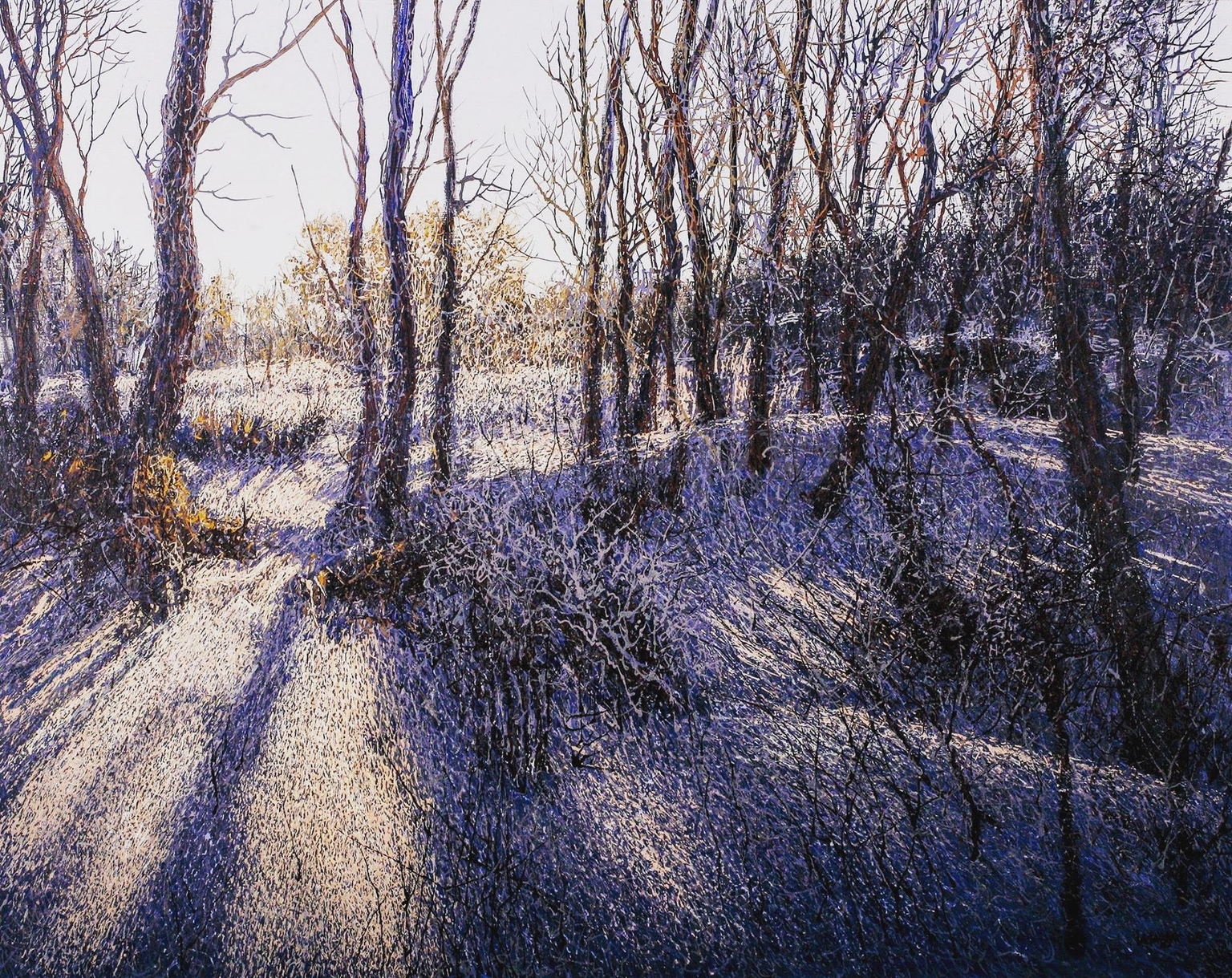
Ukrainian painter Ivan Maltyuk, widely regarded as one of the country’s most important living artists, is currently fighting for the rights to his life’s work. (Ivan Marchuk)
At nearly 90 years old, Ukrainian painter Ivan Maltyuk, widely regarded as one of the country’s most important living artists, finds himself in court fighting to maintain full creative rights to his vast body of work.
Marchuk went to court last year, saying he was tricked into signing a 100-year portion of his creative rights to three other people for Hr10,000 ($228).
The process is still ongoing.
“He has not lost hope for a fair resolution to this story. He is grateful to all the kind people who have truly supported him both in public and private life,” Marchuk’s longtime assistant Tamara Stripko told the Kyiv Independent.
“At the same time, this situation is completely unusual. A world-renowned artist is now being forced to prove that the copyright to the works he has created (more than 5,000) over his 80-year creative career belongs to him and not to a group of fraudsters.”
Marchuk said he was contacted in 2020 by former Ukrainian lawmaker Mykhail Apostol and asked to sign a non-binding letter of intent regarding licensing certain copies of his work. Apostol assured that the document has no legal effect without notarization.
At the time of the signing, Marchuk was suffering from poor eyesight after surgery and reportedly believed the words of an acquaintance the two shared.
However, Marchuk said that after reviewing the document in detail with Stripko, who was present at the signing, he realized that the agreement was something else entirely.
Mr. Marchuk reportedly contacted Mr. Apostol and insisted that he take no further action against the former lawmaker, stressing that he had no intention of ceding the rights to his artwork to anyone. Marchuk said Apostol responded by assuring him that the problem had been resolved.
“I was sure that this shameful story would end the day it began. But it wasn’t to be. Four years later, Tamara Strypko received a call from her winemaking partners. They and I formalized an agreement to use some images of my work on the labels of their products,” Marchuk detailed in a Facebook post in March.
“They informed her that at one of the establishments where they introduced their products, an unknown man claimed to be the owner of the exclusive copyright to the images of my paintings. That man turned out to be Mihailo Apostol.”
Marchuk told the Kyiv Independent that there were even clauses in the document that were related to his original work.
This clause obligates me to provide access to the original copy of any work “for the proper exercise” of the rights “within a reasonable period necessary for this,” which it defines as “within one calendar month from the moment of the first request.” Can you imagine what happens to a work of art in a month outside an artist’s studio?” he said.
“I have always sought, and still seek, to exhibit my work and give people the opportunity to enjoy art, rather than making money by selling them.”
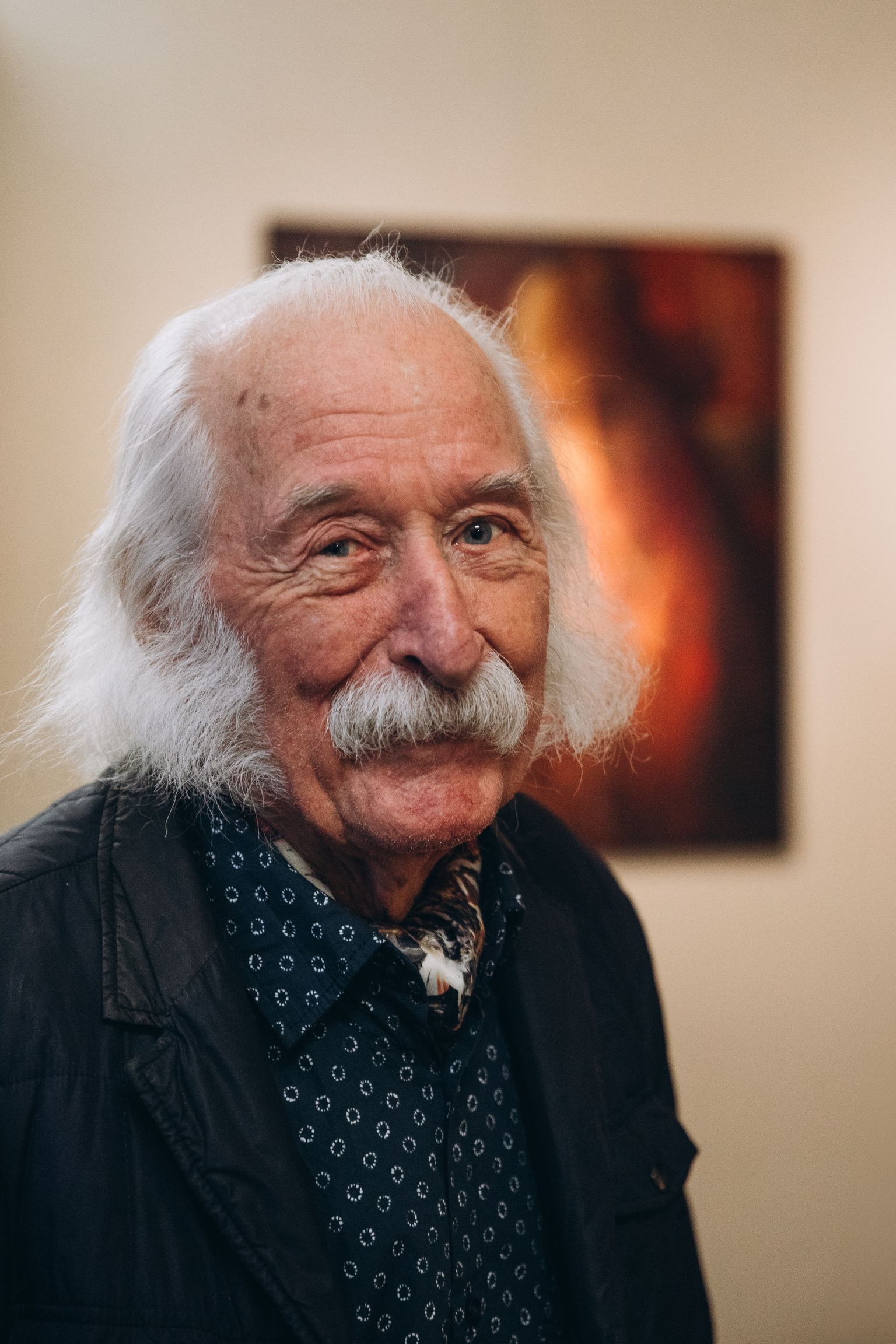
Ukrainian artist Ivan Marchuk attends the opening of his solo exhibition “Epic Reality” at Palazzo Cancelleria in Rome, Italy on February 10, 2025 (Yuriy Khanchuk/Wikimedia)
After the incident with the winemakers, Marchuk made several attempts to contact Apostol, but all attempts were unsuccessful.
Ever since the controversy gained public attention, Apostol has denied the allegations.
Part of Ms. Apostol’s efforts to fend off mounting public criticism was an effort to tarnish Ms. Stripko’s reputation, claiming in a March Facebook post that she had sole control over contracts with winemakers and exhibitions related to Mr. Marchuk’s work, as well as all financial matters related to reproductions and sales of reproductions.
“These amounts amount to tens of millions of hryvnia in total. We are sure that no taxes are paid and there is no monitoring,” he claimed. The post features an AI-generated image of a woman carrying money and legal documents through an art studio.
Apostol did not respond to the Kyiv Independent’s request for comment.
As the legal dispute continues, Marcyuk has pushed back against suggestions that he and Stripko lacked an understanding of creative license, pointing out that with Marcyuk’s permission, Ukraine’s state postal service Ukrposhta issued stamps and envelopes, and the National Bank of Ukraine minted coins based on his artwork.


But the artist says he has never prioritized either creative license or commercial gain.
“I have always wanted and still want to exhibit my work and give people the opportunity to enjoy art, not to make money by selling them,” Marchuk told the Kyiv Independent.
“Today, when many art institutions around the world offer to host my exhibition, my first condition and reservation is that it must be a presentation project and not a commercial one. I have no intention of selling the paintings, which is why I always choose state or municipal museums and galleries over commercial venues.”
Marchuk accused Apostol and his associates of being subjected to “pressure, humiliation and intimidation” throughout the legal battle and of relying on the support of senior law enforcement officials. He added that they had even filed a motion asking the court to order a psychiatric examination on him.
“For the first time during the court proceedings, it became clear that all the actions of the fraudsters were carefully planned and thought out. They recorded telephone conversations and carried out, and continue to carry out, actions aimed at discrediting the artists and witnesses,” Strypko said.
“They are now doing everything they can to delay the court process. It is likely that they still want to exert some influence on the courts and law enforcement. One thing is clear: their calculation was to wait until the artist was no longer alive. Their greed betrayed them.”
For many who have been following the case, it goes beyond questions of the personal dignity of the nearly 90-year-old artist and raises broader questions about Ukraine’s cultural heritage itself.
“Ivan Maltyuk is no longer just a person, he is a phenomenon, part of Ukraine’s cultural canon. Such figures do not appear by chance. They are formed over many years, which is why they become the face of the country,” Ukrainian artist Volodymyr Kozyuk wrote in a Facebook post.
During the Soviet era, Marchuk was repeatedly pressured by Communist Party authorities for refusing to follow the dictates of socialist realism.
In the decades since Ukraine gained independence, he has emerged as one of the country’s most respected artists. He is widely known as a cultural icon not only in Ukraine but also abroad.

Maltyuk holds the title of People’s Artist of Ukraine, one of the highest honors for Ukrainian painters, and is a recipient of the State Shevchenko Award, the most prestigious state award for art.
He is internationally known as a pioneer of the artistic method known as priontanism. Priontanism weaves together thousands of delicate interwoven lines at different angles, resulting in a unique interplay of color and light.
Long-time admirers of Marchuk’s work appreciate Stripko’s contribution to elevating his work on both international and national levels.
“She is part of the very phenomenon that is Marchuk. She has been shaping the image of Marchuk for many years, building the context, collaborating with the audience, the environment and the international presence. That is why she has the full moral and professional right to influence how and in what form this image appears in the public sphere,” says Koziuk.
Although the legal battle continues, Mr. Marchuk and Mr. Stripko hope the case will serve as a broader lesson in how states protect the rights of artists, especially when their work is as vast as Mr. Marchuk’s and deserves to be treated as cultural heritage of national significance.
“In civilized countries, people in creative professions are protected by law. Talented people have a very different mental constitution. Without trusting their surroundings, how can they create an ideal world of visual art and music, a world based on high aesthetics and harmony? “Stripko said.
“The state must protect this category of people from violations of their rights through appropriate legal regulations.”
Please also read this
Executed Renaissance: Ukraine’s cultural rebirth and its violent death
My eyes fall on a figure in the left corner of a black-and-white portrait of a well-dressed, calm family. Antin Krushernitsky is the patriarch of the family, author, educator and former Minister of Education of the People’s Republic of Ukraine. This photo, believed to have been taken in Kharkiv in the early 1930s, captures a moment of Ukraine’s cultural renaissance. Krushernitsky and his family were part of a generation of writers, artists, and intellectuals who believed that Ukrainian culture could develop.
The Ukrainian origin of avant-garde artist Kazimir Malevich, long mistakenly identified as Russian
In 2016, Natalia Zabolotna, then director of the Kyiv-based art gallery Mystetsky Arsenal, proposed naming Kyiv’s main airport, Boryspol International Airport, after the famous avant-garde artist Kazimir Malevich. Her idea was far from novel. From Rome’s Leonardo da Vinci Fiumicino Airport to Granada’s Federico García Lorca Granada Jaén Airport, airports across Europe serve as sites of cultural self-definition and bear the names of compatriots who transformed world culture. in
The life and death of Alla Horska in the Ukrainian struggle against Russia’s annihilation
Editor’s note: This article originally appeared in the first print edition of the Kiev Independent under the title “The Power Within.” You can order a copy in our e-store. Poet Vasyl Stus, who carried a portrait of Ukrainian artist Alla Horska to her funeral and would die in a Russian labor camp 15 years later, did not hesitate to call her death a murder. When it came time to speak to Stas on that heartbreaking day, he published a poem he had written in memory of Horska. That powerful opening sentence – “Toda”
#Ivan #Marchuk #Ukraines #leading #artists #scammed #Hes #fighting #lifes #work