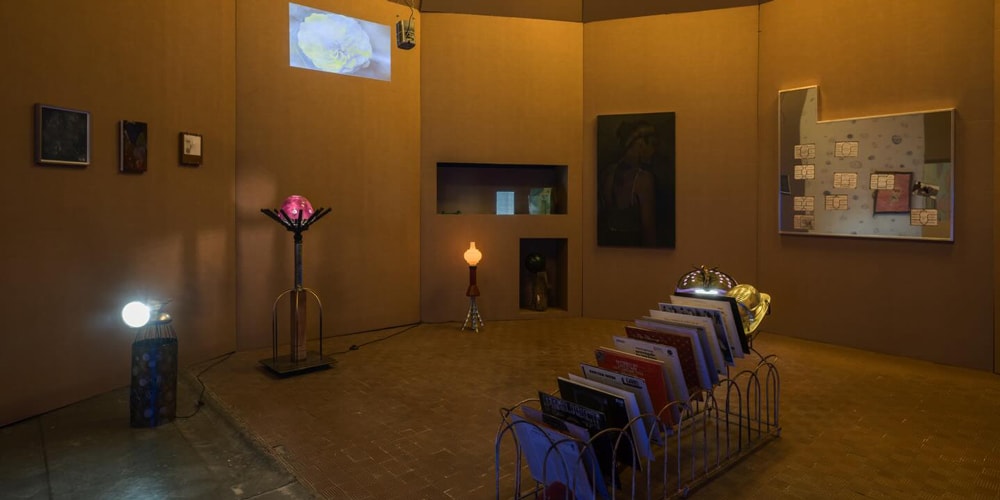
Dozy Kanu returns to the Milano Foundation ICA with a new immersive dialogue. “The Second Shadow,” on view through May 23, pairs the Houston-born, Portugal-based artist with the late Marc-Camille Chaimowitz for an exhibition that blurs the lines between sculpture, domesticity, and memory. The project, supervised by Rita Selvaggio, rejects the traditional white cube presentation in favor of two autonomous “rooms” that function as psychological landscapes.
In this parallel environment, Kanu’s contributions serve as a living archive, fusing his own sculptural practice with selections from the Nicoletta Fiorucci collection. Known for finding a high degree of artistry in repurposed materials and found objects, Kanu uses this site-specific intervention to bridge the gap between functional design and autobiographical narrative. It is a resonant look at the “double,” where influence is a constant process of refraction rather than a direct lineage.
Read below for a Q&A in which Dozie Kanu details the evolution of her practice and its results. second shadow.
“Chaimowitz’s conversational practice allows the viewer to move between two different understandings of how objects carry emotions, memories, and identities.”
How does having your work next to Chaimowitz’s room change the way people use and view your work?
My work, in close proximity to the room where Chaimowitz dedicated his eulogy to Jean Cocteau, creates a kind of conversation that transcends time and deals with domestic space, social status, and how meaning can be accumulated through proximity. Marc’s work has a very atmospheric feel. He pays close attention to the arrangement, and his sense of style and interior design shine through. My work is based on a variety of references, but I also think deeply about the domestic space as a place where cultural values are rehearsed and enacted. So, essentially, my practice in conversation with Chaimowitz allows viewers to navigate between two different understandings of how objects carry emotions, memories, and identities.
Why did you choose certain pieces from the Nicoletta Fiorucci collection to place alongside your own new works?
I tried my best not to think of this selection as a traditional curatorial exercise or as a way to build some kind of historical argument. In fact, the starting point for me was Marc-Camille Chamowitz’s association with and admiration of Jean Cocteau. He described Jean Cocteau not as a direct reference, but rather as a kind of phantom companion who accompanied his formation. That thought was close to me. I focused on selecting pieces from Nicoletta’s collection that functioned in a similar way to my own pieces. Not as a quote or influence in a direct sense, but as a work that reflects or extends a particular aspect of my artistic language.
The selection led to identifying artists and specific practices that touch on what is present in my practice, such as furniture and domestic spaces treated as sculpture, issues of ambiguous or constructed subjectivity, and materials that convey memory, whether political, personal, or discrete. Rather than express these ideas overtly, I tried to make the works sit in the space as if they were companions, and the room became a place where these different sensibilities coexist and quietly communicate information.
In that headspace, my insulation is less a curated exhibition than a kind of living environment or built interior where my work and these selected works help us think about space itself. They are not there for direct comparison, but to build a mental and emotional structure around the exhibition, in which the impact is felt spatially and atmospherically, rather than didactically.
Will exhibiting your work in a major institution like this in Milan change the narrative of the scrap metal and found objects you use?
Found or salvaged materials automatically have a previous life, a previous function, and when they enter the gallery they enter another economy of value and meaning. I’ve always been interested in that change. The same object can transition from being discarded to being saved, and that transition says a lot about how values are assigned in general.
“I hope that if people take away anything from this, it’s the idea that inheritance isn’t passive. It’s something you build, edit, and reinterpret over time.”
This show is about inheritance and succession, what do you hope people take away from the archive you’ve built here?
I tried to think about inheritance not only in terms of things, but also in terms of knowledge, references, and ways of looking at things. For me, there is a larger question of what it means to inherit a culture when our relationship to history feels fragmented or partially erased. A lot of my work is trying to build a visual language that feels like it belongs to my generation and background, but it also acknowledges what came before. Therefore, this exhibition archive is not really an archive in the traditional sense. It’s more like a personal index of influences, materials, and images that have shaped the way I think and feel. I hope that if people take away something from it, it’s the idea that inheritance is not passive. It’s something you build, edit, and reinterpret over time. Many of the artistic expressions I love don’t resonate with me on first encounter, but after years of reunion and further consideration, I eventually find a way to capture my interest.
Besides this show, what other projects are you currently working on?
Currently I’m working in a few different directions. I continue to develop sculptures and exhibition projects, but I also spend a lot of time thinking about film and architecture as long-term projects. I’m interested in movies because they allow you to build a complete world and control the emotional pace very precisely. I am interested in architecture because it operates on the scale of everyday life and community.
In the longer term, I am interested in how these different disciplines, such as object making, exhibition making, film, and architecture, can work together as different ways of shaping the way people move through space and understand their environments. For now, sculpture is just part of that larger conversation for me.
ICA Milano Foundation
Via Orobia, 26, 20139
Milan, Michigan, Italy
#Dozy #Kanu #pays #homage #structure #memory #Shadow