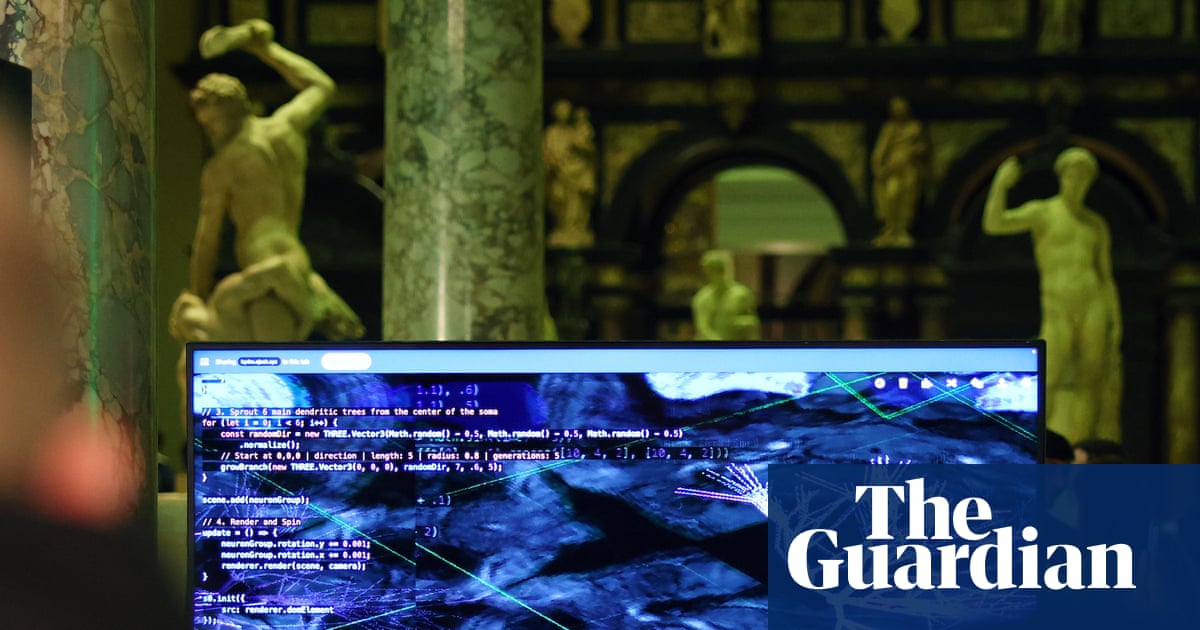
IAt the Victoria and Albert Museum’s grand entrance, beneath a looming dome with ancient statues visible through nearby arches, a programmer and DJ is busy live-coding a glitchy electronic music set. Large LED displays on either side of her strobe with streams of chords and pixelated images, accompanied by a bass rumble. She is part of a group called London Livecoding, an experimental collective that creates and manipulates audio programs to create music. Loud, disorienting, and brilliant, you can’t help but wonder what Queen Victoria and her husband would have made of it.
The set is part of the museum’s long-running Friday Late Night series in collaboration with the London Games Festival. Focusing on the connection between play and performance, we introduced a range of independent video games and immersive interactive experiences. Visitors were given a map and wandered through the halls, hallways and galleries in search of the installations. You can also play the Bafta award-winning comedy game Thank Goodness You’re Here! on a giant screen beneath a 13th-century spiral staircase. As you wander through the darkened Prince Consort gallery, you’ll find a group of giggling buddies playing the hilariously erotic physics puzzle game Sex with Friends. In this game, a ragdoll-like character must be led into a (consensual) sexual encounter, much to the amusement of the audience.
For co-curator Susie Buchan, this sense of theater was important. “I was really interested in how playing games in a gallery environment, especially when it’s large and there’s an audience, turns the player into a performer of sorts,” she says. “The highlight for me was seeing the camaraderie in the audience playing Sex with Friends. You would never expect a group of people shouting sex positions at the screen at the V&A on a Friday night to feel so strangely wholesome.”
This is not the V&A’s first exploration of gaming culture. The museum has hosted events on a variety of themes over the past decade, and in 2018 it hosted a beautiful exhibit, Design/Play/Disrupt, curated by Marie Fallston and Christian Volsing. But it had been inactive recently, and Volsing, now a senior curator, wanted to bring the game into the building and get it playing again. “Presenting and critiquing video games as a major and serious part of our culture is extremely important, and placing them within the context of a museum, with its emphasis on communal experience, does just that. By asking visitors to consider them side-by-side with objects of historical value and to share these experiences and encounters with other members of the public, we fundamentally change the way we encounter these artifacts.”
Another key element of the event was its emphasis on participation and shared creativity. Comedian and author Jamie Brew invited the entire audience to participate in his performance project, Robot Karaoke. This project uses an algorithm to generate new lyrics for classic pop songs by implementing a variety of improbable text data sets. The highlight was having the entire room sing along to Dancing Queen, using lyrics culled from negative reviews posted on Glassdoor. At the learning center, artist Frede Ranka helped participants create their own video game fanzines. I loved Yana Romanova’s light LARP experience “The Line is the Game.” Participants were given a role and then joined an unruly procession of characters for as long as they wanted in a hallway just beyond the sculpture gallery.
Author and game designer Holly Gramazio has curated numerous video game events in museums and galleries around the world, including the can’t-miss experimental games festival Now Play This at Somerset House. She believes that the interplay of gallery experiences, games, and performances are key elements for presenting video games in these environments. “There’s something special about the way both video games and exhibitions utilize many other different modes of expression,” she says. “[They] Often there is an experience in the mind of someone moving through some space and reacting to it. This makes the exhibition a very expressive and complex way to share the game and its background and history with the audience. ”
The London Games Festival in April will offer experiences like this at venues across the city. It is heartening to see similar events happening around the world. Bakan recommends Overkill festival in the Netherlands and A MAZE in Berlin. Everyone I spoke to mentioned Babycastles, a New York-based art gaming collective. Game Arts International Network maintains a list of arts organizations working with gaming events and installations. Veteran event curator and game designer V. Buckenham, who worked on the Night Car Boot Casino installation (a collection of new card-based bluffing games), sees these spaces as a virtuous cycle. While players can imagine games in different ways, non-gamers can have their expectations of the medium challenged, and developers can also gain a lot from that. You can also improvise Algorave music and visuals on a centuries-old mantelpiece or under a Chihuly. [sculpture]”
Right now, it’s all too easy to view video games through an industry lens, fixated on the billions of dollars generated by Fortnite and Roblox, and fixated on changing power structures, acquisitions, and brand extensions. Spending a few hours admiring games in an unfamiliar context, set between Renaissance paintings and Baroque silverware, is an opportunity not only to read games in a new way, but also to understand that games belong as much to culture as to commerce.
“Video games can bridge the gap between the past and present of a museum’s collection,” says Volsing. “You can relate the inspiration of the real historical materials on display to how they have been reimagined in the digital world, and moving through the five levels and 11 miles of galleries around the V&A feels very much like an open-world game.”
#Pixels #paintings #video #games #return