Architect Desmond Williams, who has died aged 93, had a specialty in designing modern Catholic churches that reflected his rare ability to combine liturgical function, architectural ambition and artistic collaboration. The quality and importance of his work was recognized during his lifetime with four of his churches listed, and his achievements placed him among the leading figures in post-war British architecture.
The growth of the Catholic population in the first half of the 20th century increased the demand for new buildings, while the liturgical reforms of Vatican II in the early 1960s had a significant impact on church design and layout. With an emphasis on communality and intimacy, traditional axial planning was rejected in favor of a more inclusive and spatially dynamic form that encouraged the active participation of worshipers.
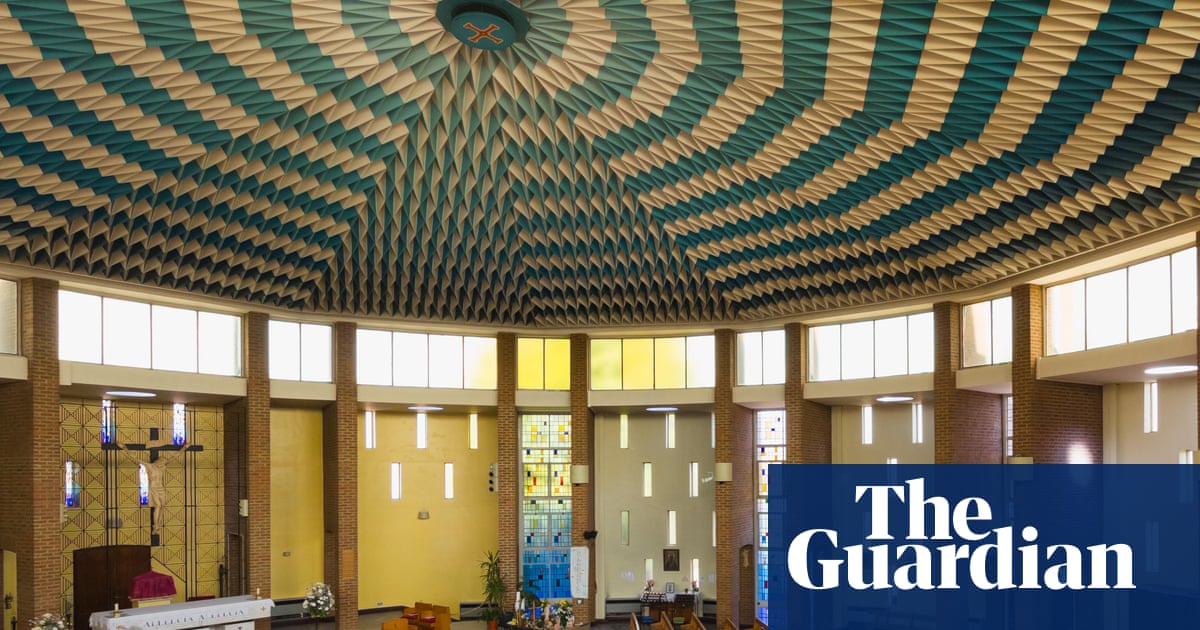
St Mary’s Church in Dunstable, Bedfordshire, completed in 1964, was typical of Williams’ work. The building’s circular form hugged the congregation widely and brought them closer to the altar. But the real drama lay in the spectacularly intricate tetrahedral ceiling, resembling a giant delicate origami paper made from 600 aluminum pyramids bolted together with alternating blue and white bands. A modern heavenly vault. As Williams explained, “The ceiling was inspired by my previous visit to King’s College Chapel in Cambridge,” which features the elaborate stone latticework of a medieval fan vault.
Symbolizing the Vatican’s call for “noble simplicity,” Williams’ church was bold yet disciplined, marked by a confident use of materials, proportions, and acoustics. In its listing of St. Mary’s Church, Historic England noted that it was “an important early work in the career of Desmond Williams, an architect known for innovative church architecture at a time of great change in church architecture”.
His other Grade II listed Catholic churches are St Dunstan’s in Birmingham, St Michael’s in Wolverhampton and St Augustine’s in Manchester, all completed in 1968.
Collaboration has been at the heart of Williams’ practice. At St. Augustine, we worked closely with ceramist Robert Brumby, whose reconstructions of impressive sculptures and Pierre Fourmantrau’s abstract stained glass aimed to enhance and enrich the architectural structure. The result is a unified and strong liturgical space that embodies the progressive, interdisciplinary spirit of 1960s British modernism.
Desmond was born in Manchester’s Warley Ranges, the son of Sidney Williams, a draftsman of submarine electrical systems, and his wife Eleanor, a devout Catholic, and was educated at St Bede’s College in the city, where his early interest in architecture began to take shape. A formative moment came when, as a teenager, he visited Coor Abbey near Ryde on the Isle of Wight.
The simple brick interior of the monastery, its harmonious proportions and the powerful combination of architecture, music and liturgy left an unforgettable impression. For Williams, it instilled a lifelong interest in the relationship between space, sound, and spiritual experience. His determination to pursue architecture was further strengthened by a cycling trip around East Anglia, where he explored Norwich Cathedral, along with local churches and historic houses.
Williams studied architecture at Manchester University’s School of Architecture, and his contemporary was Donald Buttress, who became structural surveyor at Westminster Abbey.
After gaining qualifications, he briefly partnered with Arthur Fairbrother of Altrincham and secured early commissions from churches and schools. His first work as a project architect was St Catherine of Siena, Didsbury (1957), designed in the Romanesque basilica style.
He then set up his own practice in Manchester at the relatively young age of 28 and developed strong professional links with the Department of Education and Science, which led to a steady flow of work. Williams designed many schools and colleges, including a major expansion of Ampleforth College, a Catholic boarding school founded by Benedictine monks at Ampleforth Abbey in 1803. His educational work was characterized by a rigorous understanding of planning, adaptability, and efficiency, while balancing educational ambitions with practical constraints.
In 1968, Williams formed a partnership with the Liverpool-based firm W & JB Ellis, which enabled him to expand his practice. This evolved into Ellis Williams Architects, which now has studios in London, Berlin and across the north of England. Later in his career, Williams did more consulting work, particularly in the field of educational facilities, but he continued to do so until the mid-’90s.
Beyond his practice, he played an influential role in the wider profession. He was Chair of RIBA’s North West Region, President of the Manchester Institute of Architects, Advisor to the OECD on Educational Development and RIBA’s Design Coordinator for the Forum on Education and Higher Education. He was considered a generous mentor, encouraging and supporting successive young architects.
He was appointed to the Order of the British Empire in 1988. Despite his professional success, he remained humble. After retirement, he enjoyed pursuing his interests in aviation and orchestral organ music.
He has four children, Dominic and Sarah, and twin sons Andy and Jez, from his second wife Susan (née Richardson), whom he married in 1988, and his first marriage to Felicity (née McDonnell), which ended in divorce in 1964.
#Desmond #Williams #obituary