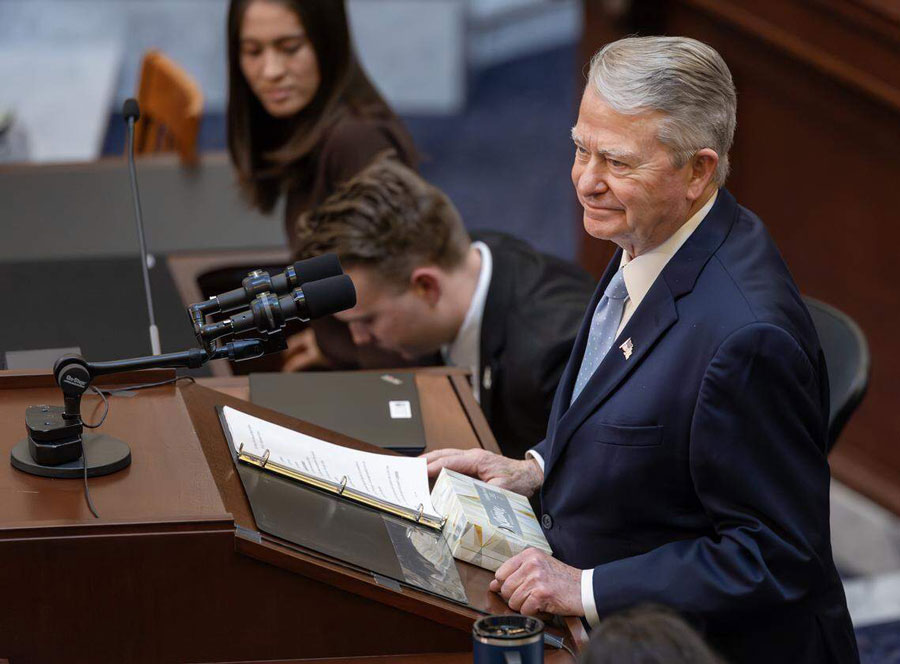
BOISE, Idaho (Capital Sun) – Idaho Gov. Brad Little signed a bill Thursday that restores the Medicaid mental health treatment program that the state cut to comply with the governor’s budget-cutting orders.
Less than three months after an Idaho Medicaid contractor shut down a mobile treatment program for people with severe mental illness, four patients have died, the Idaho Capital Sun reported. In the 18 months leading up to the cuts, only one patient had died, according to health care providers. This program was designed for people who are struggling in everyday treatment settings.
Senate Bill 1446 would spend one-time legal settlement funds to restore a mobile treatment program called the Assertive Community Treatment Program and peer support services to help people navigate mental health treatment.
The move to restore cut mental health programs stands out as an exception to the Legislature’s hawkish fiscal stance, as the 2026 legislative session was defined by deep spending cuts across state government to avoid budget shortfalls and make room for One Big Beautiful Bill Act tax cuts. Medicaid disability providers received about $22 million in pay cuts this year. And Congress did not consider a bill that would restore other cut health programs, including those for children with disabilities.
The reinstatement of the mental health program comes after warnings from health care providers and sheriffs, two lawsuits, an admission that the cuts likely won’t save the state money in the long run, and a denial by state officials that services for people with severe mental illness were cut.
“We recognize the self-inflicted challenges to our state’s budget due to the Legislature’s overly aggressive tax-cutting stance and the executive branch’s collusion in continuing to cut tax revenues, creating budget shortfalls,” Bonneville County Sheriff Samuel Hulce, president of the Idaho Sheriffs Association, wrote in a letter to legislative leaders and the governor in December. He warned that the cuts “represent serious concerns for public safety.”
Republican senator says layoffs could lead to more deaths
Shortly after Idaho’s Medicaid contractors announced the cuts, providers and the Idaho Sheriff’s Association warned that the cuts could jeopardize public safety, and providers said the cuts would further increase other costs. A crisis center in eastern Idaho saw a surge in demand after the cuts.
Providers have since called for the program to be reinstated, and several state lawmakers have spoken out about the deaths as the Legislature considers other budget cuts.
The proposed budget earmarks funds for next fiscal year’s reduction program, which begins in July. The program is also expected to be reinstated this fiscal year if the Idaho Department of Health and Welfare transfers enough funds internally, which the agency has said is possible.
Sen. Kevin Cook, R-Idaho Falls, cited patient deaths in his argument for reinstating the program.
Since the program was cut, “there have been four deaths directly attributable to the eliminated program,” Cook told senators. “Our sheriffs, our EMTs, our courts are dealing with the same people over and over again. These are people who fly frequently… because this system that was designed to stabilize them has been taken away from them.”
A bill introduced in February by Sherry Republican Rep. Ben Fhilman to reinstate the program into state law failed to pass a committee hearing. But he said the funding in the budget proposal will help Idaho communities.
“This funding will ensure that those who truly need this level of support will continue to receive it, and our communities will be safer and stronger because of it,” Farriman said in a statement. “But the work is far from over. There remain significant mental health challenges across Idaho, and we must continue to find ways to properly fund and protect these programs so we never find ourselves in a situation like this again.”
Rick Boyce, one of a group of clinic owners and health care providers who called for the program to be reinstated, said Cook and Fouriman “worked tirelessly” to reinstate the Assertive Community Treatment program.
In February, when a reporter asked the governor if he would have responded differently after the first two patient deaths were reported, the governor said, “Hindsight is a wonderful thing.”
At the time, Little told reporters it was difficult to predict “unintended consequences.”
Next fiscal year, the bill allocates $4.6 million in tobacco settlement funds and $5.8 million in opioid settlement funds to the program. The federal government would pay most of the costs to restart the program. The total cost is approximately $31 million, with an estimated cost of $20.5 million.
AJ McWhirter, a spokesperson for the Idaho Department of Health and Human Services, previously told the Sun that if JFAC’s bill becomes law, the agency would have enough one-time funding to restart services this year.
Three of the dead were men in their 40s.
Providers told the Idaho Capital Sun that at least three of the dead were men in their 40s.
Meredith Sievers, the medical provider for the fourth patient, learned that the patient had died after missing an appointment. After the cuts, visits were reduced to once a week.
“He actually did very well,” Sievers told The Sun. “I had achieved sobriety over the last few years. I was starting to go back to work and was looking to become a recovery coach for people with other substance use disorders.”
After the third death, Laura Skuri, owner of the clinic that treated him, told The Sun it was preventable. He also said he was concerned that the cuts could lead to serious incidents of violence, as people with severe mental health problems would be denied access to treatment.
“I’m worried that it’s going to be a child, an innocent child who was in the wrong place at the wrong time, who will be hurt by an aggressive psychopath,” Sukri said.
The first death could have been prevented, Boyce, owner of a Chubbuck-based mental health clinic, said in a statement in federal court. He said the patient died from a minor surgical complication that resulted from him refusing follow-up care or not sticking to his treatment plan.
If the ACT program had still been in place, Boyce wrote, staff would have “identified the increased risks associated with postoperative complications” and involved “appropriate medical personnel as appropriate.”
Instead, one of his clinicians visited the patient’s home and observed the funeral, Boyce wrote.
Later, when the same clinician visited the home of another former patient in the ACT program, he was informed that they were “experiencing an acute psychiatric emergency and required immediate transportation to the hospital for evaluation and stabilization.”
Why State Contractors Cut the Medicaid Program
State health officials denied that the Assertive Community Treatment Program as a whole had been cut, saying the service was still available. However, some health care providers argue that the services still available do not resemble evidence-based programs because providers do not pay mobile treatment team staff.
The contractor, Magellan, received a pay cut from the Department of Health and Human Services last year as part of a pay cut for Medicaid providers after Gov. Brad Little ordered state budget cuts. Magellan cut its services in December.
Lori Wolf, the governor’s budget director, told the Sun in February that preventive services are often the first thing states address when they face a fiscal crisis. That’s because preventive services are one of the few options states have.
The state’s Medicaid director told lawmakers in December that health officials weren’t sure the cuts would save the state money in the long term.
About 200 people are participating in the ACT program in Idaho, Magellan Healthcare’s Idaho executive director David Welsh said in a December statement following a federal lawsuit filed by patients.
The Idaho Capital Sun is part of State Newsroom, a nonprofit news network supported by a coalition of grants and donors as a 501c(3) public charity. The Idaho Capital Sun maintains editorial independence. If you have any questions, please contact editor Christina Rose at info@idahocapitalsun.com.
=htmlentities(get_the_title())?>%0D%0A%0D%0A=get_permalink()?>%0D%0A%0D%0A=htmlentities(‘For more articles like this, be sure to visit https://www.eastidahonews.com/ for the latest news, community Event, details.’)?>&subject=Check%20out%20this%20story%20from%20EastIdahoNews” class=”fa-stack jDialog”>
#patient #deaths #Idaho #governor #approves #reinstatement #cut #Medicaid #mental #health #program #East #Idaho #News