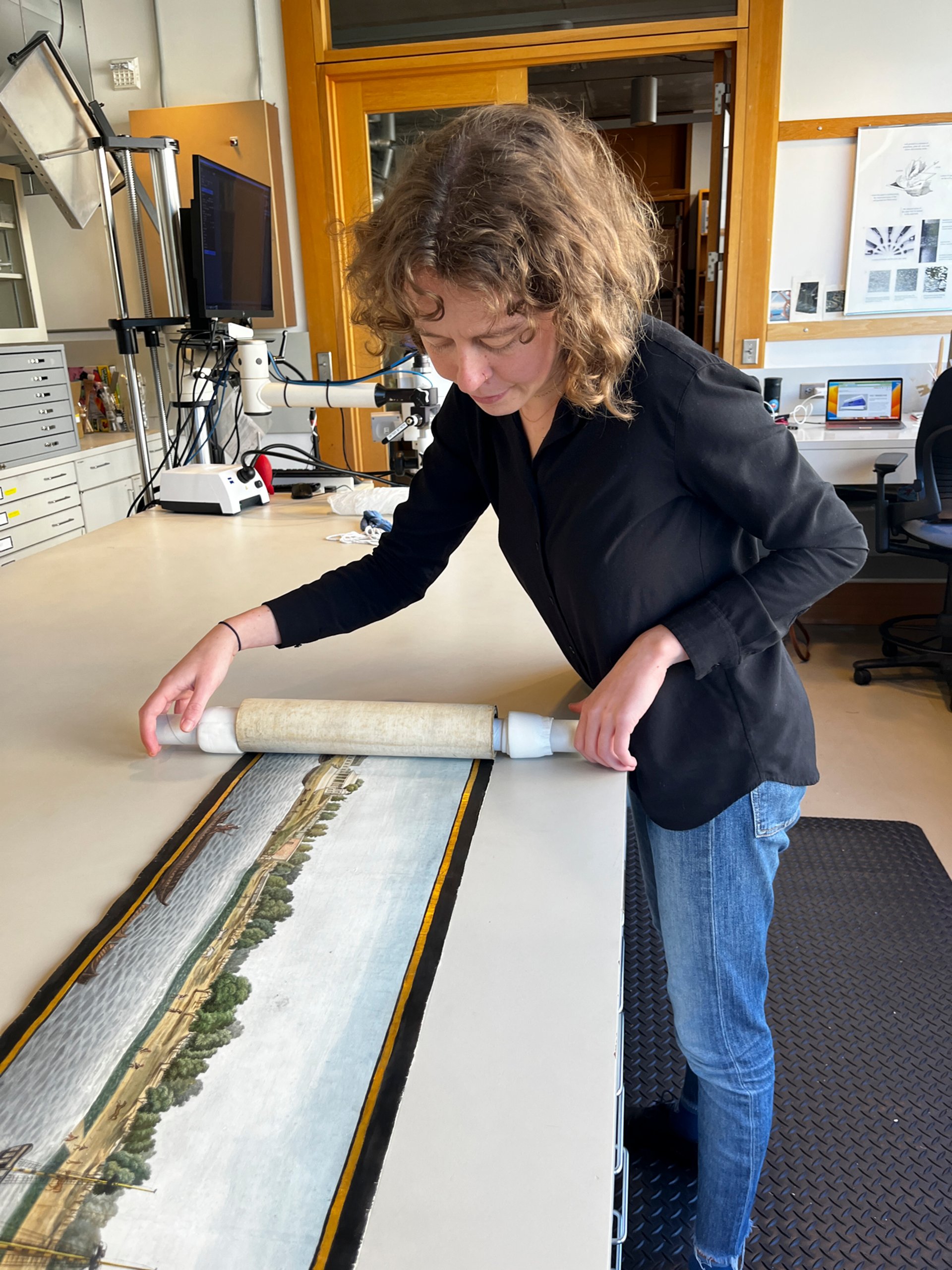
After two years in storage, the 37-foot-long early 19th-century scroll will be on public display for the first time at the Yale Center for British Art (YCBA) in New Haven, Connecticut. This object known as the Lucknow Scroll is part of the exhibition Painters, Ports and Profit: Artists and the East India Company, 1750-1850 (until June 21) Gives a material focus to issues of empire, commerce, and artistic exchange. Due to the large size and fragility of this scroll, half of it will be on display at once and will be expanded throughout the exhibition, giving repeat visitors the opportunity to see different sections. (Displaying objects partially can also help reduce light exposure.)
Scrolls range in size from hand-held to even larger than the Lucknow example, and have served a variety of purposes. “Story scrolls have been a popular art form within the artistic tradition of the Indian subcontinent,” say exhibition curators Laurel O. Peterson and Holly Shafer. art newspaper. “These were made for people at all levels of society. Unrolling the scrolls often told a story of faith that unfolded. In early 19th-century England, scrolls were used for home entertainment and may have even been made into souvenirs.” Although scrolls were printed in large numbers, they were considered a luxury item.
Emma Hartman, paper conservator assistant at the Yale University Art Museum, unfolds the Lucknow Scroll. Photo: Anita Day, Image courtesy of Yale Center for British Arts
The Lucknow Scrolls, or Lucknow from GomtiThe work was created between 1821 and 1826 and consists of 33 overlapping sheets of paper painted in watercolor, gouache, and gold. From the other side of the Gomti River, you can see a vast view of Lucknow in northern India.
“The Lucknow scrolls can be considered in terms of storytelling, as they allow the viewer to follow the journey along the banks of the river,” say the curators. “An English key written in 1826 describes the work as a ‘panoramic view of Lucknow’, suggesting a connection between the two forms. However, a panorama represents a landscape from a fixed rather than a continuous perspective.”
From palaces to warehouses
The scroll was created during the reign of Qazi al-Din Haidar Shah, who declared independence from the Mughal emperor in 1819 and embarked on an ambitious building campaign, and depicts palaces and mosques, as well as workshops, warehouses, and regional structures.
“This scroll contains a fascinating story, both historically and materially, in part because it is so mysterious,” the curators say. “We do not know the name of the artist who made it.” The patron is also unknown, they added, but the inscription “doesn’t put much emphasis on the company, indicating that the scroll was likely made for or in honor of the ruler, perhaps at the request of an elite female retinue.” It is also possible that it was part of military or political negotiations.
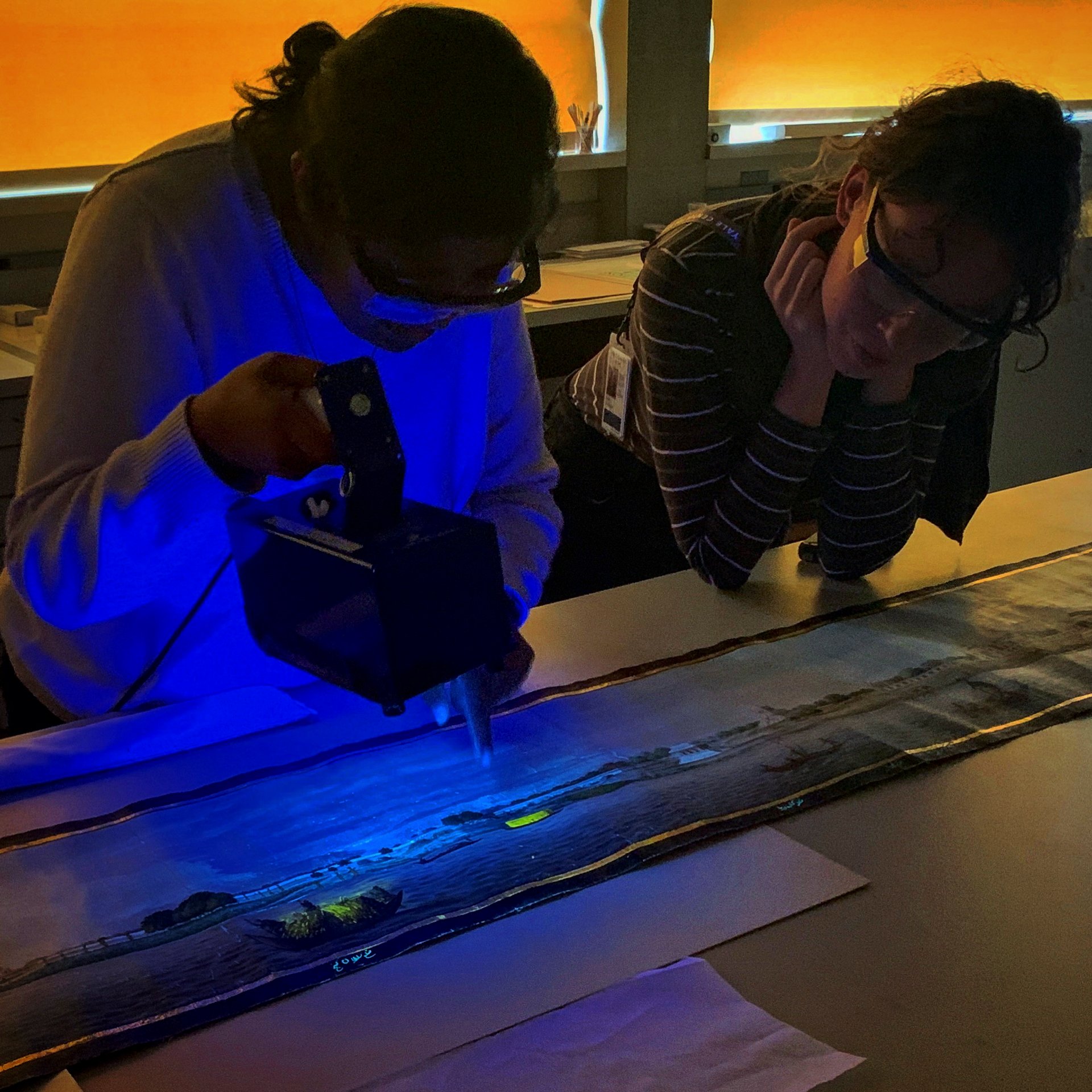
Anita Day, assistant paper conservator at the Yale Center for British Art, and Emma Hartman, assistant paper conservator at the Yale University Art Museum, examine the Lucknow scroll under ultraviolet light. Photo: Jessica Makin, Image courtesy of Yale Center for British Arts
Over the years, the scrolls developed pigment instability and structural weaknesses. “The main conservation challenge was the scroll’s complex layered structure,” says Anita Day, assistant paper conservator at YCBA. “It consists of several pieces of paper strung together, with another layer of paper and a cotton fabric lining. While this construction helped protect the scroll from the wear and tear associated with handling throughout its life, it also created large plane distortions, making it impossible for the object to lie flat as originally intended.”
The conservation process at YCBA began with stabilization to prevent further loss and flatten the object so it could be safely unfolded and displayed. Among the notable discoveries uncovered during conservation were watermarks from the James Whatman factory in England, a discovery that helped narrow down the scroll’s age and understand it within a wider trade network.
- Painters, Ports and Profit: Artists and the East India Company, 1750-1850Yale Center for British Arts, until June 21
#monumental #37footlong #Indian #scroll #public #display #time #Yale #Center #British #Arts